There is a story about how Madhubani painting first came to be known outside of Bihar. In 1934, a big earthquake hit the region. British officers surveying the damage went into the villages of Madhubani district in Mithila and found that many of the mud walls of houses had collapsed, exposing the interior walls, which were covered in intricate painted art. Fish, elephants, peacocks, lotus flowers, wedding scenes, all done by the women of the household for religious and celebratory occasions.
This was the first time the wider world encountered Madhubani painting. But the tradition itself was already thousands of years old.
Today Madhubani art appears on paper, on greeting cards, on kurtas, on sarees, and yes, on cotton blouses. It has moved from the mud walls of Mithila villages into wardrobes across India. The tradition has expanded, but the core motifs and the specific visual language have stayed remarkably intact.
What Madhubani painting actually is
Madhubani painting, also called Mithila painting, is a folk art tradition from the Mithila region straddling northern Bihar and southern Nepal. The name Madhubani means "forest of honey" and refers to the district where the tradition is most concentrated.
It began as ritual art done by women. Traditionally, Madhubani paintings were created on freshly plastered mud walls for weddings, births, festivals, and religious ceremonies. The paintings were meant to invoke blessings, ward off evil, celebrate deities, and record important family events. When a woman got married in a Madhubani-practising family, she painted the walls of her marital home as one of her first acts.
The colours came from what was available. Yellow from turmeric. Red from kumkum or vermillion. Black from soot mixed with cow dung. Green from beel leaves. Blue from indigo. All natural. All ground fresh for each painting.
The motifs and what they mean
Madhubani is not decorative art in the abstract sense. Every motif has meaning.
Fish: Fertility, life, prosperity. Fish are one of the most common motifs and appear at weddings especially.
Lotus: Purity, spiritual awakening, feminine energy. Often shown with a Devi figure or as a standalone symbol.
Peacock: Beauty, love, and the arrival of monsoon. Peacocks are drawn with elaborate tail feathers that fill the composition.
Elephant: Strength, prosperity, royal blessing. Often shown carrying a rider or with decorative saddle work.
Sun and moon: Cosmic order, the passage of time, presence of the divine.
Bamboo: Family, extension, lineage. A common wedding motif.
Krishna and Radha: Divine love. Frequently painted for weddings and Krishna Janmashtami.
Durga, Kali, Saraswati: Devi figures, painted for festivals and pujas.
Wedding scenes: Detailed narrative panels showing bride, groom, family members, priest, sacred fire, and rituals.
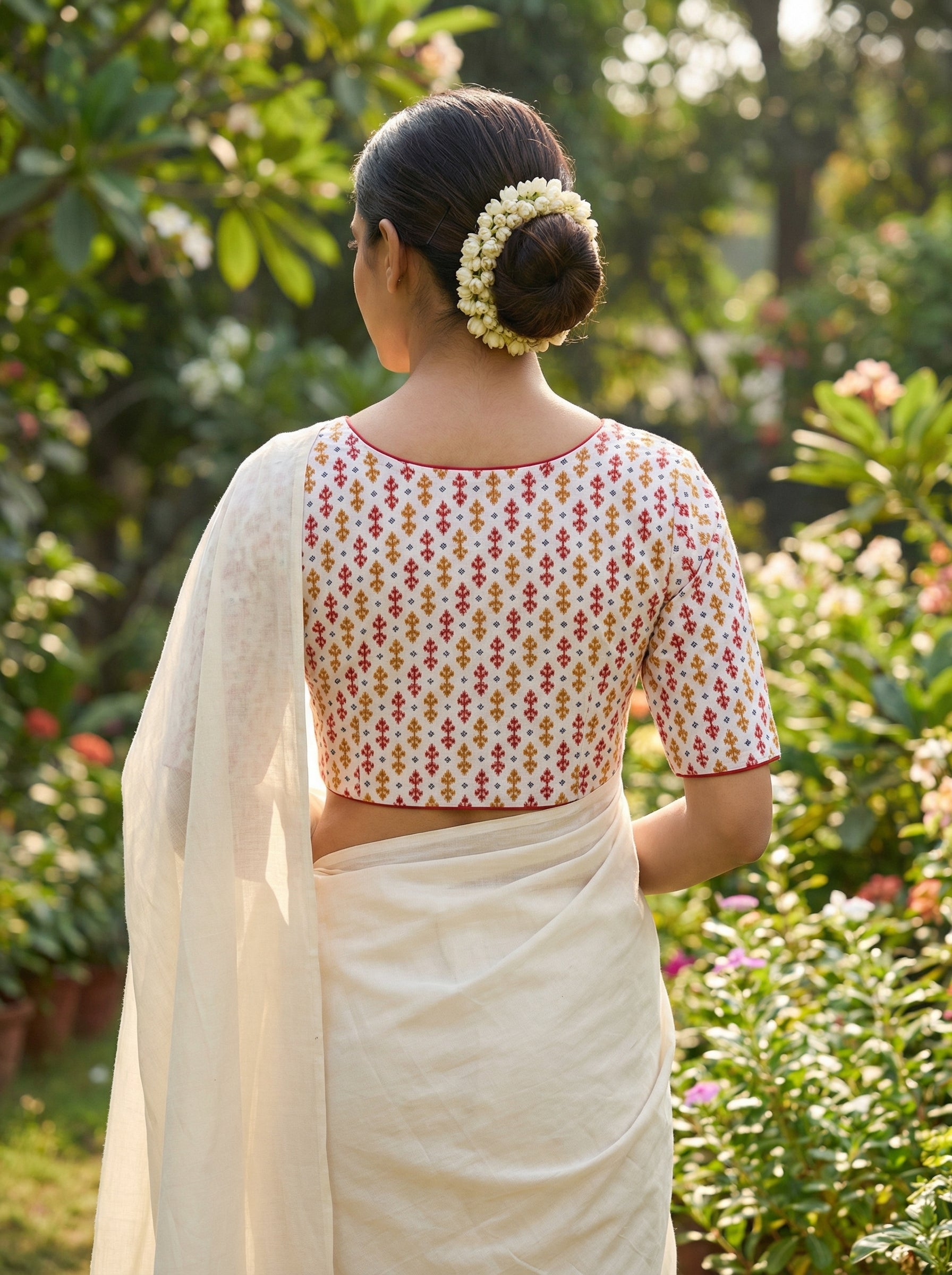
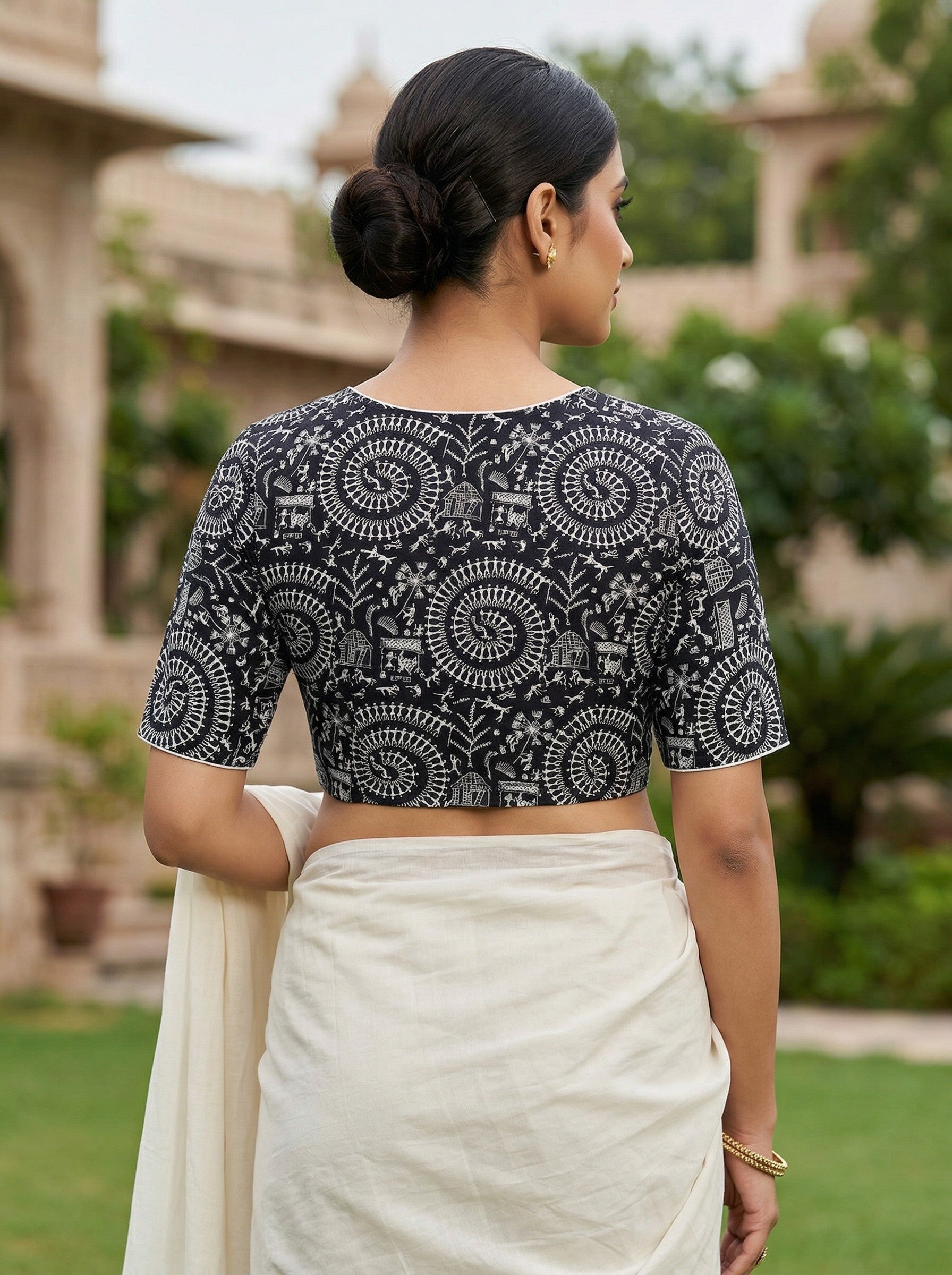
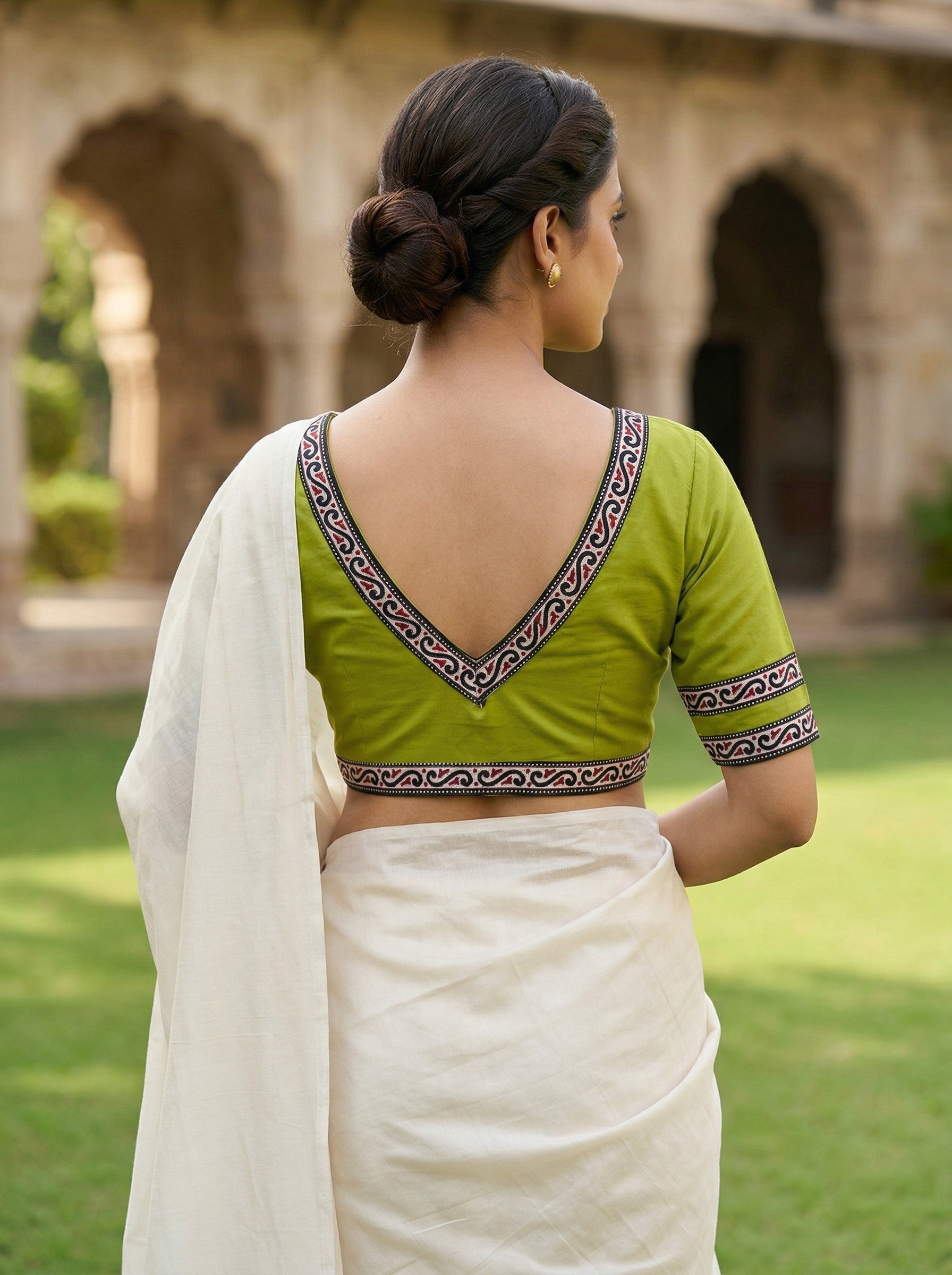
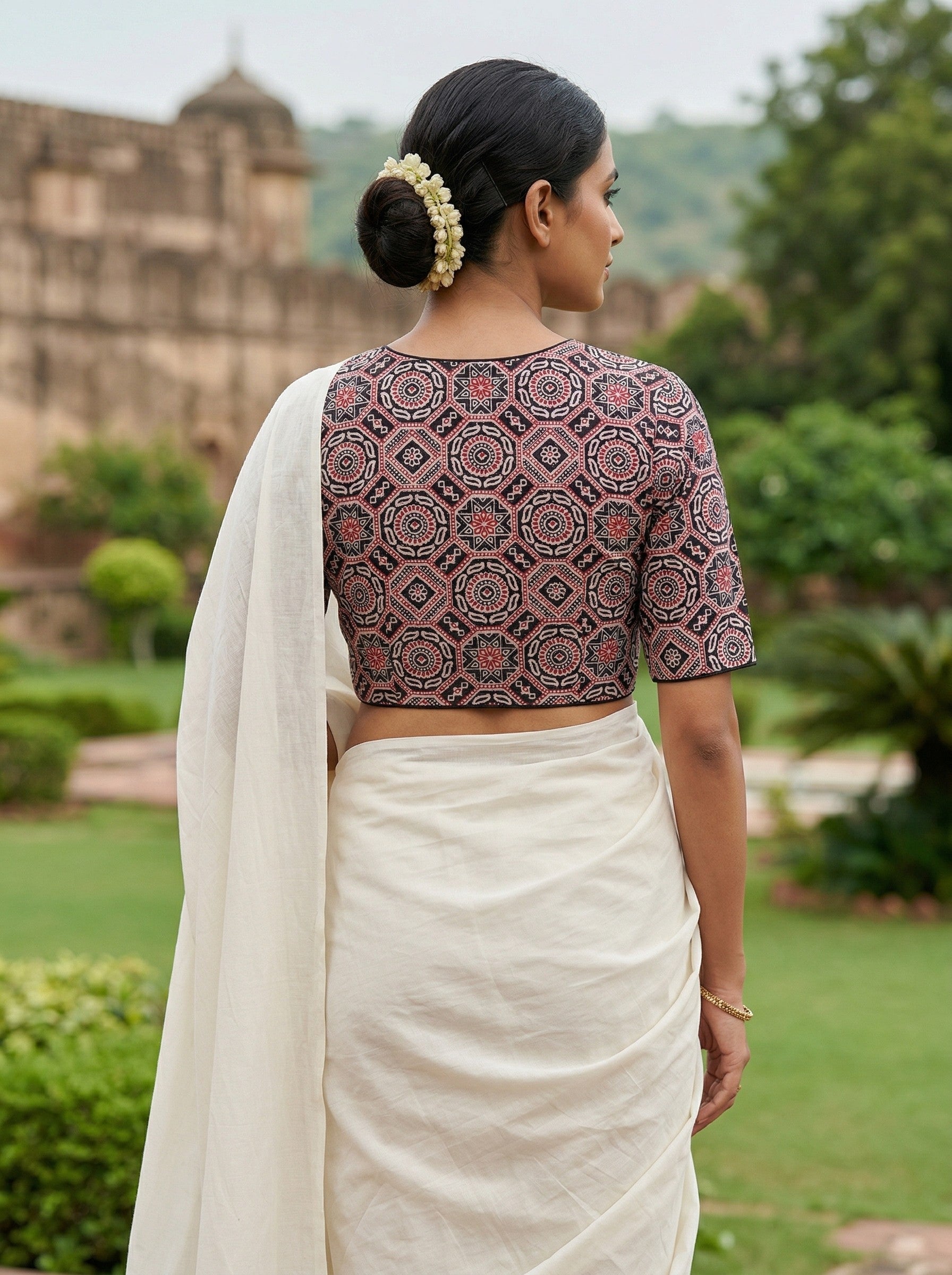
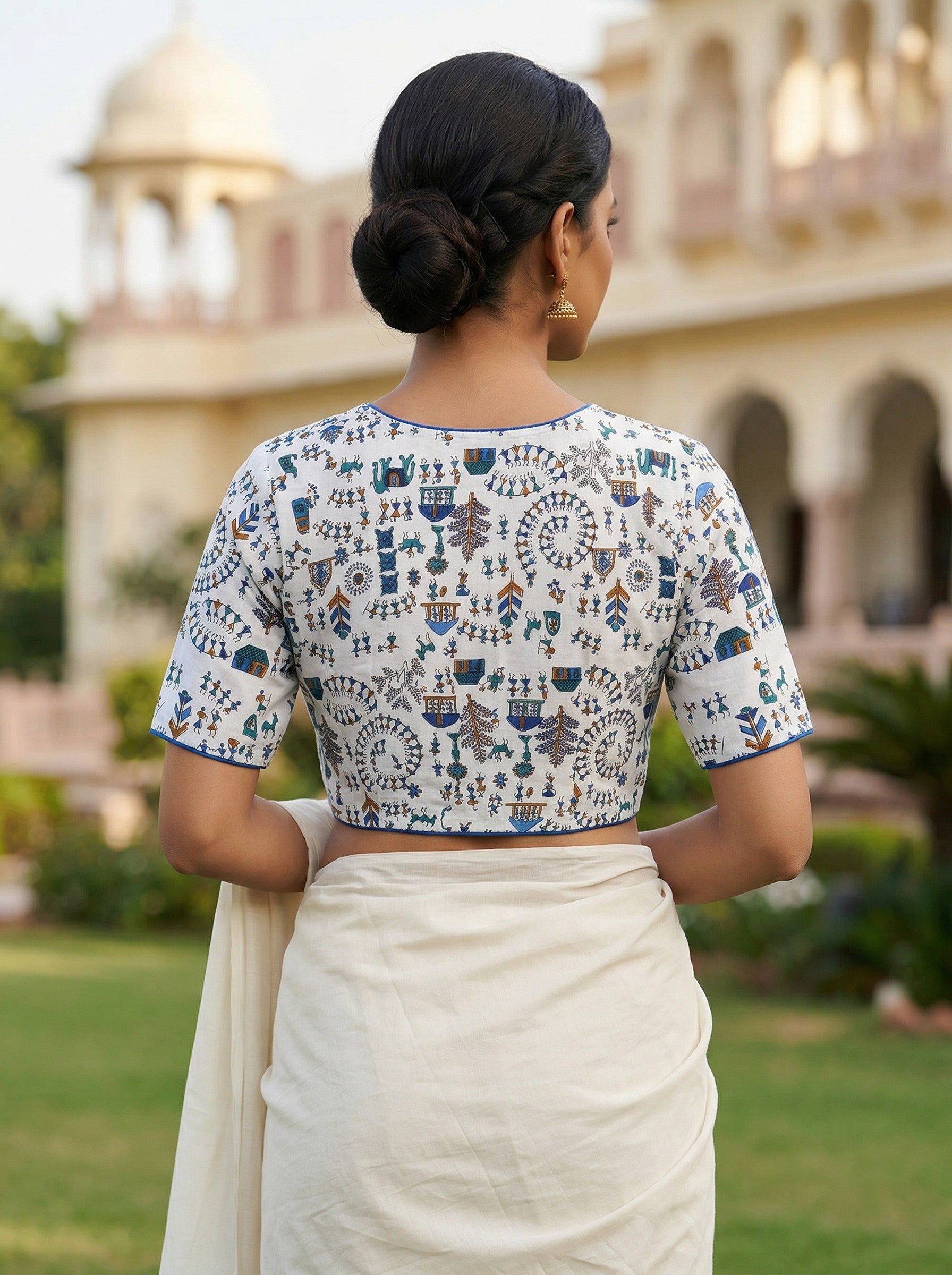
When a Madhubani cotton blouse features specific motifs, they are not arbitrary. A wedding blouse might carry fish and peacocks. A festive blouse might have lotus and sun motifs. A general wear blouse might have geometric bamboo patterns.
The three styles of Madhubani
Traditionally, Madhubani painting has three main sub-styles.
Bharni style: The most colourful. Motifs are filled in with colour, with black outlines drawn in ink. This is the style most commonly seen on modern blouses and sarees because it reads well against fabric.
Katchni style: Uses only fine lines, no colour fill. The whole composition is done in cross-hatching and delicate line work, usually in one or two colours only. Elegant and understated.
Godana style: Named after "godna" or tattoo work. Small dense repetitive motifs, often used for background fills or geometric borders.
Most Madhubani cotton blouses today combine elements of Bharni and Katchni styles, with colour-filled central motifs and Katchni line work around them.
From wall to fabric
The move from mud walls to paper began in the 1960s and 1970s, when government art institutions started encouraging Madhubani artists to paint on paper as a way to earn income and preserve the tradition. This is when Madhubani first became a commercially traded art form.
The move to fabric came later, in the 1990s and 2000s. Artists began painting on cotton sarees, dupattas, and eventually blouse pieces. The fabric changed how the paintings were done. On mud walls, the porous surface absorbed the natural pigment. On cotton fabric, the artists had to use fabric-safe pigments that could withstand washing.
Today, high quality Madhubani on cotton uses either natural dyes with proper fabric fixing or fabric-safe acrylics. Both can produce beautiful, long-lasting work. What matters is the artist's skill, not just the pigment.
Real hand-painted Madhubani versus prints
The market has three broad categories of "Madhubani" cotton blouses.
Hand painted by a Madhubani artist: An artist from Bihar or trained in the tradition paints each blouse individually. Prices usually start around fifteen hundred rupees for a blouse piece and go up depending on the artist's reputation. Each piece is unique. Small variations show the human hand.
Hand painted by a general fabric artist: Someone with painting skills but not specifically Madhubani trained. The motifs might be reasonable but lack the specific visual grammar of authentic Madhubani. Priced lower, still hand painted.
Screen printed: Reproduced from a hand-painted original using screen printing. Uniform, mass-produced, priced much lower. Not real Madhubani in the strict sense, but affordable and often visually pleasing.
None of these are automatically bad choices. The question is what you are paying for and what you are getting.
For a serious Madhubani cotton blouse that you want to keep for years, buy hand-painted from a reliable source. For a first-time try or a lower budget, a good screen print is a reasonable entry.
How to tell them apart
Look at the motifs closely. Hand painting has small variations in line thickness, spacing, and detail. Every fish looks slightly different. Every peacock has slightly different feather work. Screen printing has perfect uniformity.
Feel the surface. Hand painting has slight ridges where the paint sits above the fabric. Screen printing sits flat.
Check the back of the fabric. Hand painting sometimes shows slight paint bleed on the reverse. Screen printing usually does not.
Look at price. A real hand-painted Madhubani blouse piece from a legitimate seller is rarely below one thousand rupees. A stitched blouse from it will be two thousand or more.
Why we make Madhubani cotton blouses
At Sayani's Creation, we work with Madhubani artists from Bihar to hand paint blouse pieces on cotton. The pieces then come to our Shantiniketan workshop for tailoring and finishing.
Not every blouse in our collection is hand painted. We do offer high quality screen printed Madhubani blouses for customers who want the aesthetic at a lower price point. We label them clearly. What you see is what you pay for.
Our blouses are cut to fit Indian body types, sizes 30 to 44, with proper darts and adjustable back closure. Delivery pan India in four to five working days for most locations, with cash on delivery available.
Care instructions
Hand painted Madhubani is more delicate than block prints or embroidery. Treat it accordingly.
Cold water only, always. Hot water can lift or soften the paint.
Mild detergent, hand wash gently, do not wring or twist.
Wash separately for the first two washes. Some pigment may release into the water. This is normal.
Do not soak. In and out of the water within twenty minutes.
Dry in shade. Never direct sun, which fades pigments quickly.
Iron on the reverse side only, medium heat, never directly on the painted motifs.
Store folded with butter paper between the paint areas if the design is heavy. Cotton bag, not plastic.
Handled kindly, a hand painted Madhubani cotton blouse will look good for three to five years of regular wear.
Featured Product in this Article
 View
View
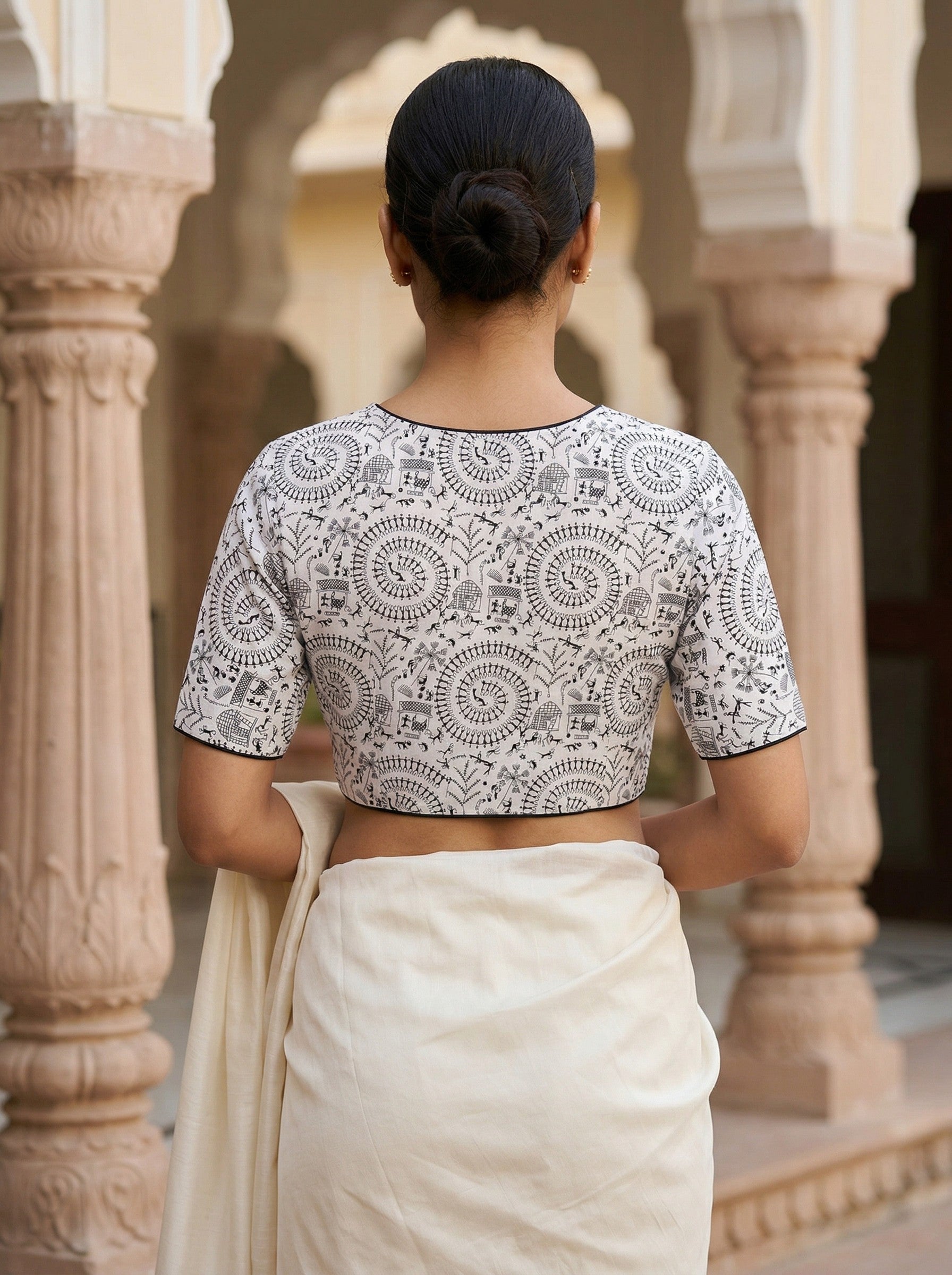
White Cotton Readymade Saree Blouse with Madhubani Art (Size 30–42)
Frequently asked questions
Are your Madhubani blouses painted by artists from Bihar?
Yes, our hand-painted range is done by artists from the Madhubani district. Our screen printed range uses designs originally created by these artists but reproduced through screen printing for affordability.
Will the paint come off if I wash it?
Not if the blouse is made properly and you follow the care instructions. The pigment is fixed to the fabric using a fabric-safe process. Very slight colour softening over years of washing is normal, but the design remains intact.
Can I wear Madhubani to a formal wedding?
Yes, for receptions and non-ceremonial functions. A well-made Madhubani cotton blouse under a silk saree is a very acceptable and increasingly popular choice for South Indian weddings and Bengali wedding receptions.
What is the difference between Madhubani and Mithila art?
They are the same tradition with two names. Madhubani refers to the district in Bihar where the tradition is most concentrated. Mithila refers to the broader region, which includes parts of Bihar and Nepal.
Do you offer custom Madhubani work with specific motifs?
Yes. Custom orders for wedding blouses with specific motifs like fish, peacocks, or the couple's names can be arranged. Custom work takes fifteen to twenty working days.