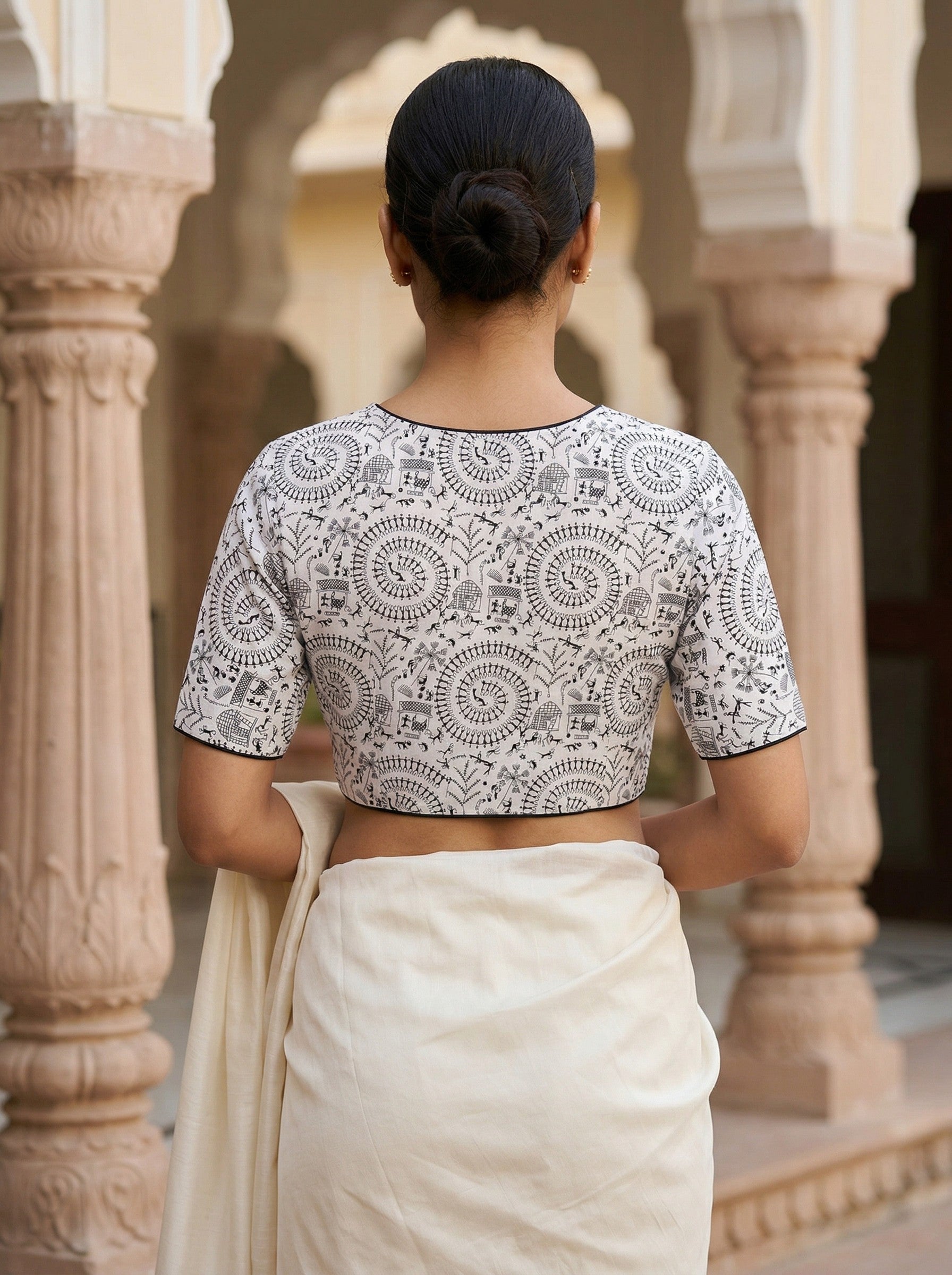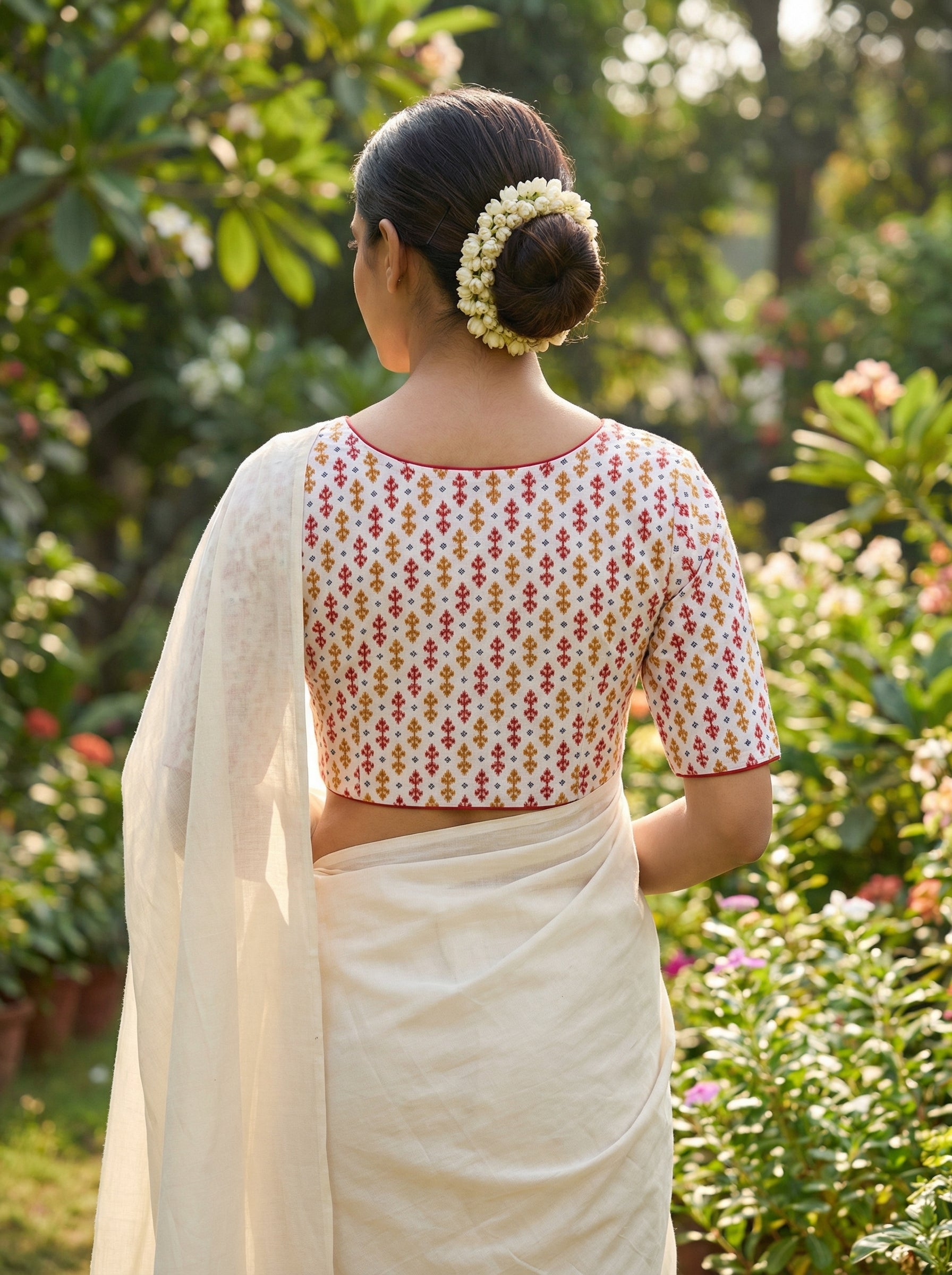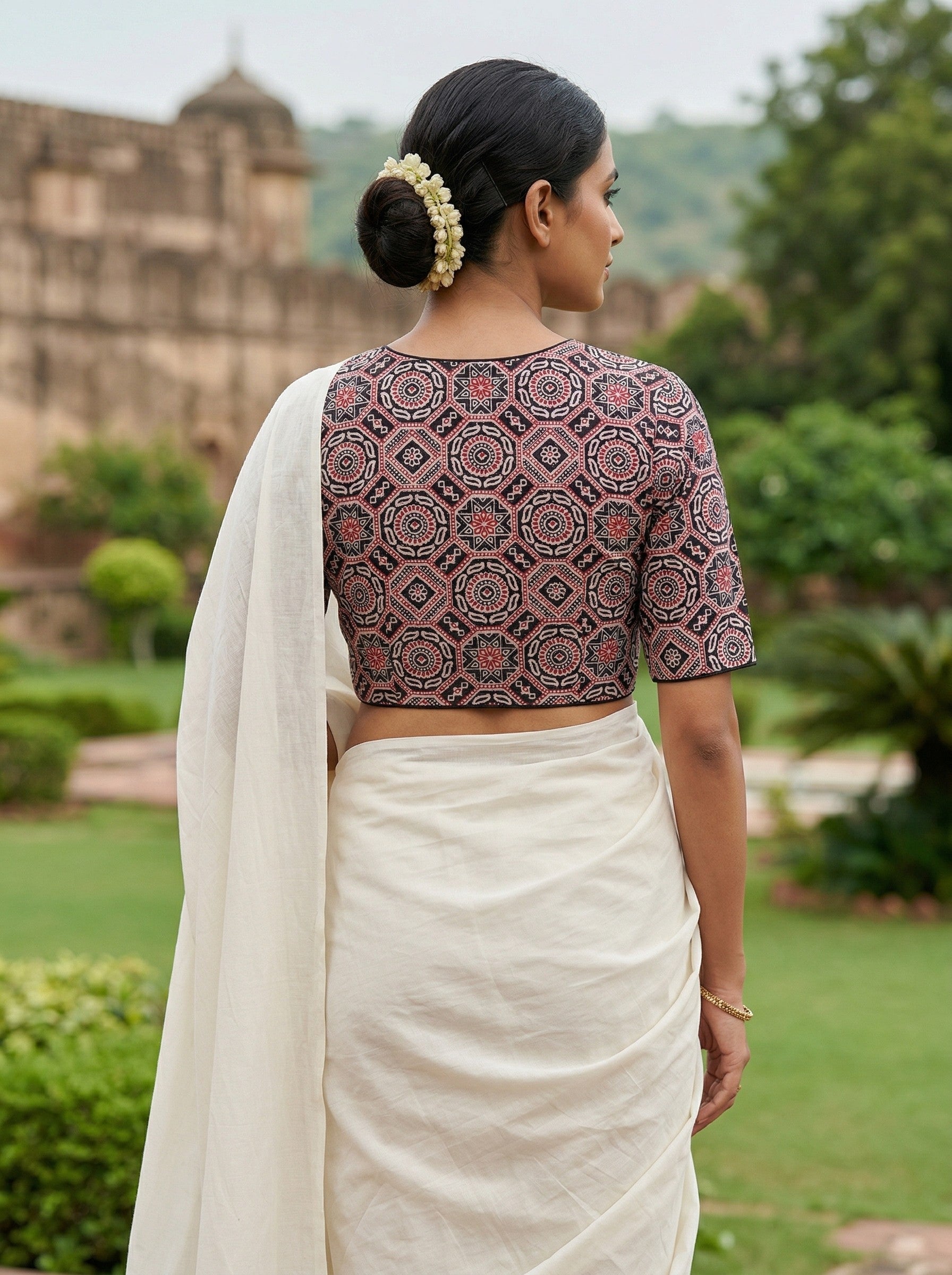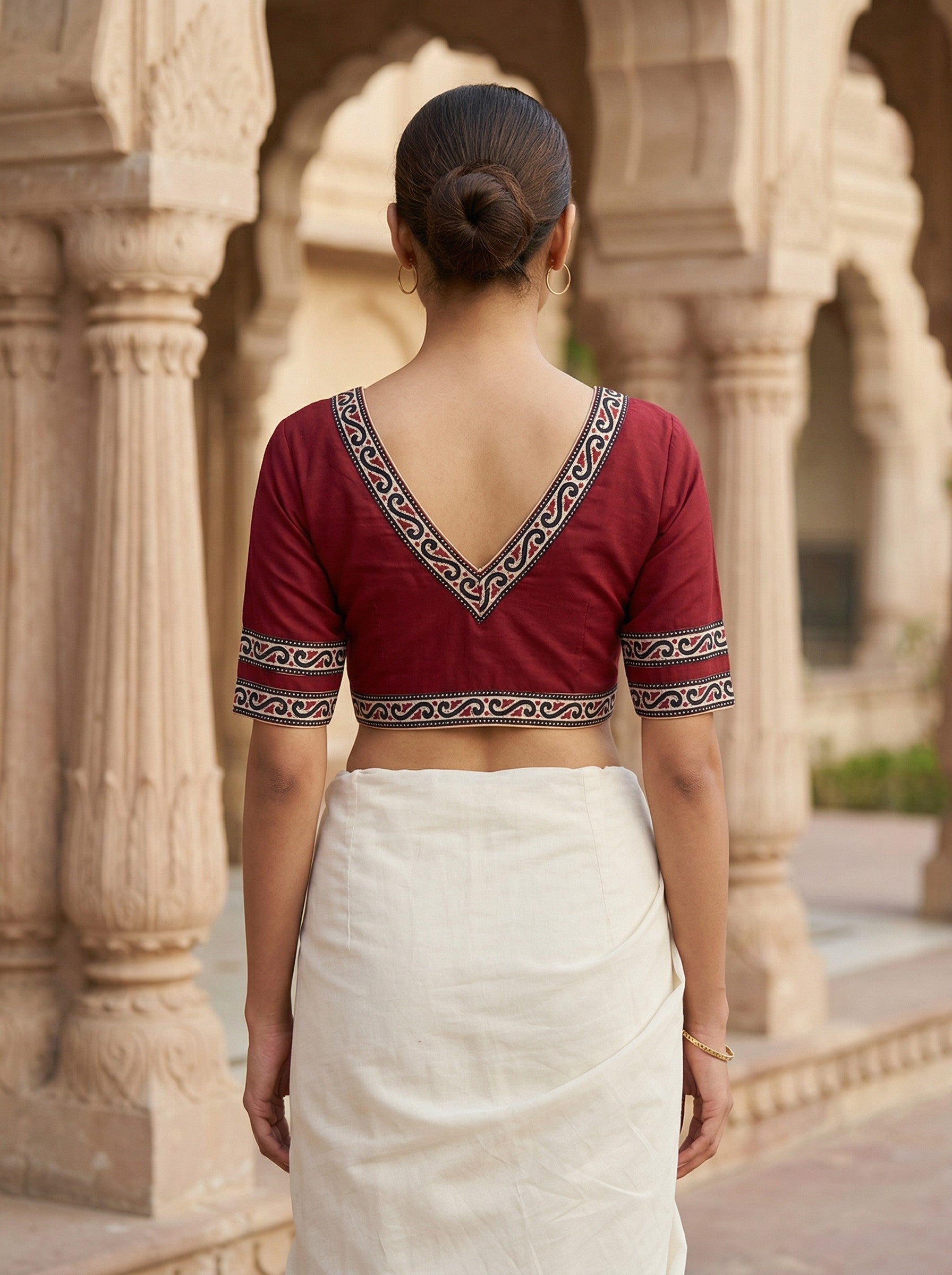
If you own an Ajrakh cotton blouse, or you are thinking about buying one, it helps to know what you are actually wearing. Because Ajrakh is not just a print. It is one of the oldest continuing block printing traditions in the world, done by the same families in a small stretch of Kutch and Sindh for over four thousand years.
That is not an exaggeration for marketing. Archaeologists found Ajrakh-style block print fragments in the Indus Valley civilization sites. The craft has changed very little since then. Same natural dyes, same wooden blocks, same slow multi-stage process. When you wear a real Ajrakh piece, you are wearing an unbroken thread that runs from Mohenjo-daro to today.
Where Ajrakh is actually made
Ajrakh comes from two places. The village of Ajrakhpur in Kutch, Gujarat, where the Khatri family community moved after the 2001 earthquake damaged their original village of Dhamadka. And Sindh in what is now Pakistan, where the craft's other main branch still lives.
In India, the Ajrakhpur community is small. A few hundred families, all connected to the same craft, working out of small workshops that look like nothing much from the outside. Long rows of printed cloth drying in the sun. Big brass vessels holding fermenting indigo. Wooden blocks stacked on shelves, some over a hundred years old, passed down like family jewels.
The Khatri families call themselves the keepers of the craft. Most of them can trace their block printing lineage back at least five generations. The knowledge is not written down anywhere. It moves from father to son and now, increasingly, from mother to daughter as women take on more of the workshop roles.
What makes Ajrakh different from other block prints
India has many block printing traditions. Bagru, Sanganeri, Dabu, Bagh, Kalamkari. Each has its own personality. So what is specific about Ajrakh?
The colours are natural: Indigo blue from indigofera tinctoria plants. Madder red from madder root. Iron black from rusted iron and jaggery fermentation. Pomegranate yellow from pomegranate rind. Turmeric for occasional accents. These are the only colours real Ajrakh uses.
The patterns are geometric: Not floral, not narrative. Ajrakh's motifs are stars, jaali (lattice), scallops, medallions, and repeating grid patterns. There is a mathematical calm to real Ajrakh that other block prints do not have.
The process is multi-stage: A single Ajrakh piece goes through fourteen to sixteen separate stages of printing, washing, drying, and dyeing. It takes fifteen to twenty days to complete one length of fabric. This is why real Ajrakh is not cheap and cannot be produced in large quantities quickly.
The print appears on both sides: Traditional Ajrakh is called "do rukhi", meaning double sided. The fabric is printed on both sides, in perfect alignment, so it can be worn either way. This is a serious display of craftsmanship.
The process, briefly
Understanding the process helps you understand why Ajrakh costs what it does.
First, the cotton is washed and beaten to remove any starch or oil. Then it is soaked in a mixture of camel dung and soda ash for a day to prepare it for dye absorption.
Then comes the first printing. A resist paste, usually lime and gum arabic, is stamped onto the fabric in the areas that should stay white. Then more mordanting.
Then indigo dyeing. The cloth is dipped into fermented indigo vats, taken out, dried, and the process is repeated until the blue reaches the right depth. Each dip takes about half a day.
Then madder red is added by hand in specific areas. Then iron black. Each colour goes through separate printing, dyeing, and washing cycles.
Finally, the cloth is washed multiple times in flowing water, ideally in the Rukmavati river near Ajrakhpur, to remove excess dye and stabilise the colours.
This is why a real Ajrakh cotton blouse feels different from a machine-printed imitation. The dye has penetrated the fabric, not just sat on the surface. The colours have depth. The cloth has been touched by human hands at every stage.
How to tell real Ajrakh from imitations
The market has plenty of Ajrakh-style prints that are not really Ajrakh. Here is how to check.
Look at the reverse side. Real Ajrakh has the print showing clearly on both sides, in good alignment. Screen-printed Ajrakh has faint or missing pattern on the reverse.
Feel the fabric. Real Ajrakh cotton has body but softens with washing. Imitations often feel stiff, thin, or slippery.
Check the colours. Natural dye Ajrakh has a slight softness to the colours. The red is a warm madder red, not a bright chemical red. The blue is indigo, which has a slight greenish undertone, not a cold synthetic blue.
Ask about the source. Sellers who work with real Kutch Ajrakh will happily tell you the name of the printer or the family or at least the village. Sellers who cannot or will not tell you where the fabric came from are probably selling imitations.
Look at the price. A real Ajrakh cotton blouse piece from a legitimate source usually costs between one thousand and twenty five hundred rupees. A stitched blouse from good tailoring adds another five hundred to a thousand. If you see "authentic Ajrakh" for four hundred rupees, it is almost certainly not real.
Why Ajrakh works so well on a blouse
Ajrakh cotton is medium weight and breathable. It sits well against skin, does not need lining for most sleeve styles, and handles Indian humidity better than any polyester alternative.
The colours are earthy but rich. Deep indigo blue, warm madder red, sometimes a touch of yellow or black. These are colours that read as sophisticated rather than loud, and they pair beautifully with jewel-toned silk sarees.
The geometric patterns are visually calm. They give the eye structure without competing with the flow of a saree pallu.
And there is something to the story of it. When someone asks where your blouse is from, you get to say Kutch, Khatri family workshop, natural dye, hand block printed over two weeks. That is a different kind of answer than "I got it on a random online store."
What we sell at Sayani's Creation
At Sayani's Creation, we source Ajrakh cotton directly from Ajrakhpur through a partnership with a Khatri family workshop we have been working with for the last three years. Our fabric is naturally dyed and hand block printed. We do not claim every single piece is from the oldest family or the master printer, because that would be dishonest. We claim that the fabric is real Ajrakh, made using the traditional process.
We cut and tailor the blouses in our workshop in Shantiniketan, West Bengal, where we have proper Indian body-type sizing from 30 to 44 and custom sizing available.
Our Ajrakh blouses ship pan India with delivery to major cities in four to five working days. Cash on delivery is available across most Indian states.
Caring for your Ajrakh piece
Because real Ajrakh is naturally dyed, it needs a little care to keep the colours strong.
First wash before wearing. Cold water, mild detergent, gentle hand wash. Some colour will come off in the first wash. This is normal. Rinse until the water runs clear.
Wash separately for the first three washes. Ajrakh cotton will bleed a bit in early washes and you do not want your other clothes catching that dye.
Do not soak. Wash and rinse in one session, not more than thirty minutes total.
Dry in shade always. Direct sun fades natural dyes faster than anything else.
Iron on medium heat, on the reverse side if the print is dense. Never on direct maximum heat.
If cared for properly, an Ajrakh cotton blouse will look good for at least three to four years of regular wear, and often longer.
Featured Product in this Article
 View
View
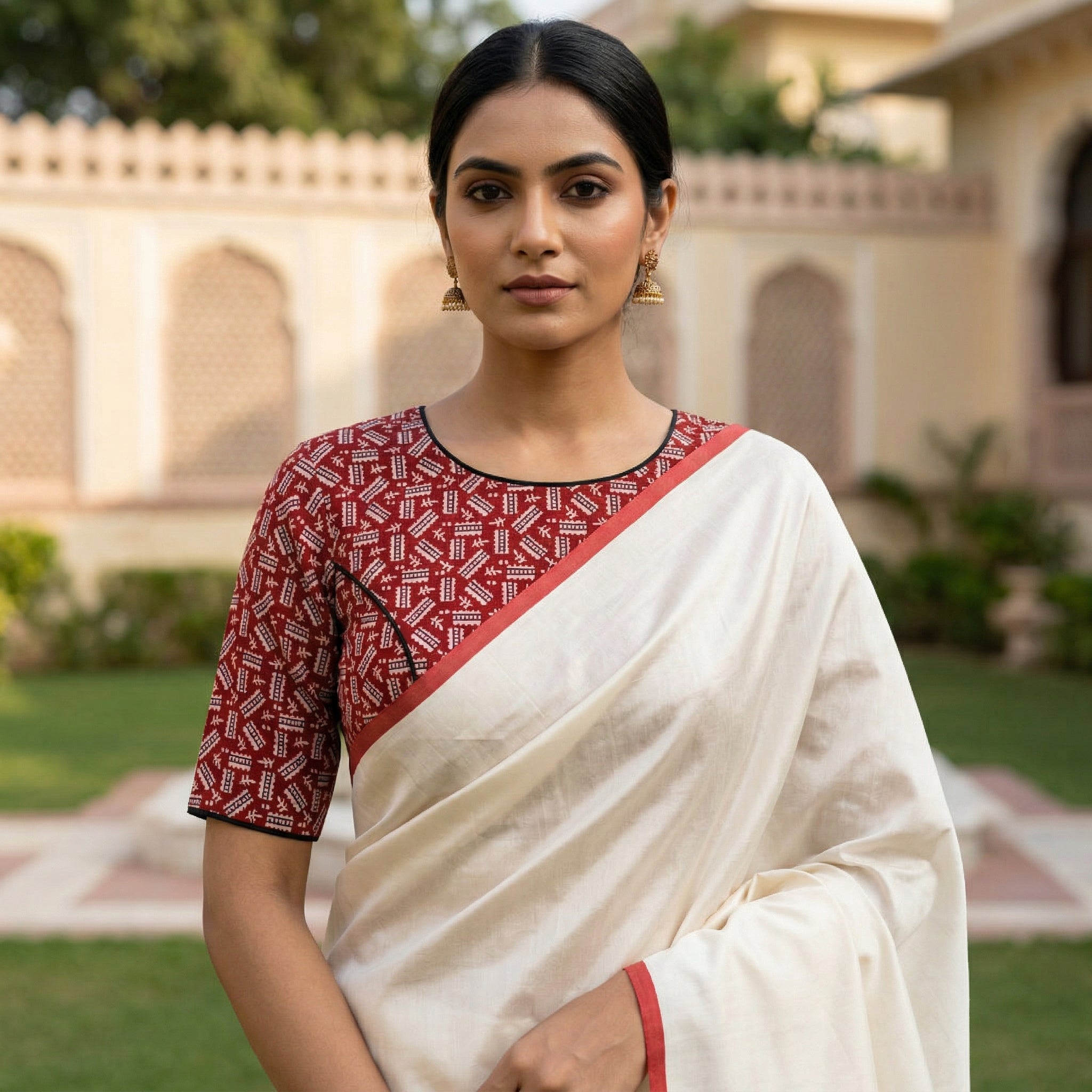
Red Cotton Printed Saree Blouse in Ajrakh Block Print (Size 30–42)
Frequently asked questions
How old is the Ajrakh tradition?
Textile historians and archaeologists date the origins of Ajrakh-style block printing to the Indus Valley civilization, around 2000 to 3000 BCE. The specific craft as it exists today has been continuously practised for at least four to five hundred years in Kutch.
Is Ajrakh only made in Kutch?
The Indian centre is Ajrakhpur and Dhamadka villages in Kutch, Gujarat. The tradition also exists in Sindh in Pakistan, done by the same historical community that split during Partition. Ajrakh from either side is authentic, but Indian Ajrakh specifically comes from Kutch.
Can Ajrakh be worn in summer?
Yes, especially in summer. Cotton Ajrakh is one of the most breathable and comfortable fabrics for hot Indian summers, which is why it originated in a desert region.
How long does an Ajrakh piece last?
With proper care, a good Ajrakh cotton blouse will look presentable for four to six years of regular wear. Natural dyes soften slightly over time but do not fade dramatically if care instructions are followed.
Do you sell Ajrakh blouse pieces or only stitched blouses?
Both. Stitched blouses in standard sizes, blouse pieces for local tailoring, and custom stitching are all available.